Home > News > 2010 Christmas Shipping Deadlines View Cart Contact Us
Products

Archive for the ‘Customer Support’ Category

2010 Christmas Shipping Deadlines

Wednesday, December 15th, 2010

UPS has announced the following as shipping holidays:

  • Christmas Day – December 25, 2010
  • New Years Eve – December 31, 2010
  • New Years Day – January 1, 2011

On Christmas Eve, December 24,  ONLY Next Day Air shipments will go out to be delivered on Monday, December 27th,  but it will be a regular delivery day.

Our shipping cutoff for delivery before Christmas is:

  • 10am PST on Thursday, December 23 for Next Day Air
  • 10am PST on Wednesday, December 22 for 2nd Day
  • 10am PST on Tuesday, December 21 for 3 Day

As of Friday, December 17 we are no longer guaranteeing ground shipments for Christmas delivery

Repeaterstore Holiday Hours

Repeaterstore.com customer service holiday hours will be as follows:

  • Christmas Eve, December 24: 8am – 2pm PST
  • Christmas Day, December 25: Closed
  • New Years Eve, December 31: 8am – 2pm PST
  • New Years Day, January 1, 2010 – Closed
 

How a Cell Phone Repeater ‘Boosts’ Your Cellular Experience

Thursday, September 30th, 2010

A “radio” receives a signal from another radio through the airwaves.  WiFi, Bluetooth cordless phones & cell phones are all radios. In the case of a cell phone, the signal is coming from a ‘tower’ that can be up to 10 miles away. When our cell phones transmit/receive a signal back & forth to these towers, a call is completed. A wireless broadband card (also known as a USB modem / mobile broadband or aircard) operates the same way a cell phone does; it receives and sends a signal to a tower. Both cell phones & broadband internet cards are totally dependent on the carriers signal (AT&T, Verizon, Sprint, T-Mobile etc).

Each carrier tries to provide a good usable signal, but unfortunately, many obstacles exist that the carrier cannot overcome: trees, valleys, hills, cement or brick buildings and buildings with metal roofs or metal siding or basements.  These obstacles block or hinder the normally adequate signal which results in broken or dropped voice calls and very slow or non-existent internet service.

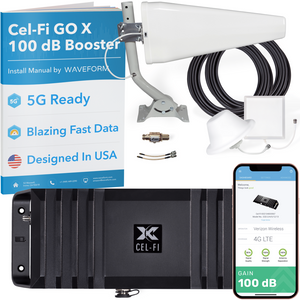
Dropped phone calls and slow internet service can be remedied with a cellular booster or repeater kit.  A repeater kit helps this communication by ‘re-transmitting’  the callers signal using:

  1. An internal antenna to receive the cell phone signal inside the building, home, car or boat,
  2. A cellular amplifier,
  3. An external antenna to send a signal to the cell tower. These components are joined together by coaxial cables.

Home or building kits can be customized using different lengths of cable for multiple interior antennas. These antennas can be on a single floor or on multiple floors. The cost of these kits can range from $250 for a small home or RV to $2500 for a large home with multiple floors.  Commercial buildings may require a couple of repeater kits to supply signal to areas from 20,000 to 100,000 square feet.

Whether it’s mobile, home or office that leaves your phone or data card silent, we can tailor a repeater kit for you to bring those essential tools back to life!


Causes of bad cell signal (and can a repeater help?)

Sunday, March 18th, 2007

The majority of our customers visit RepeaterStore looking for a solution to their own, very specialized, cell signal problems. A common situation is a home or office with few or no signal bars and frequently dropped calls. Whether or not a repeater can help in this situation depends on the cause of the problem – which you the customer can usually determine quite easily.

Poor cell phone reception is an ubiquitous problem across the United States, and the causes of bad signal fall under two categories: localized poor coverage due to building materials or destructive interference, and geographical distance from or obstacles between your phone and the nearest cell tower.

Let’s deal with the latter first. Say you live in the middle of a desert, miles from a town or major road. If you are physically too far away from the nearest cell tower, and have to drive a couple of miles to get a signal, a repeater is unlikely to be able to help you, because it cannot create a signal where one does not exist already. Similarly, if you live on the side of a mountain, and the cell tower is on the other side of that mountain, a repeater is not likely to able to pick up a strong enough signal through that obstacle to improve your coverage.

So geographical reception barriers are often insurmountable. Fortunately, they are relatively rare. The cause of your bad cell signal is far more likely to be due to the construction materials used in your home or office, or destructive interference from the buildings around you. Cellular signals have a hard time passing through metal and concrete within the walls of your home. That’s why you might gain two or three bars of signal by hanging out of an upstairs window. Obviously, you can’t make all your cell phone calls like that (!), but you can set up a cell repeater there, magnifying the good signal to an internal antennae within the walls of your house and bypassing the ‘blocking’ effect of the building walls. Many buildings also use a wire mesh in their construction called a Faraday cage. This mesh blocks external static electricity fields, meaning that cell phone signals cannot get through.

Destructive interference runs along similar lines and is a particular problem in built-up areas. If you can’t get a signal in your Manhattan apartment, it’s obviously not because Cingular/Sprint/Verizon etc coverage is poor there. In cities, cell signals will be reflected from walls and other barriers and many separate signals will be found traveling in different directions. These different signals will interact with each other and some of these can be diminished in strength, which results in weaker cell signal for you. Luckily in these cases you will probably be able to get a reasonable signal nearby, and so again, a cellular repeater is an excellent solution. This article from slate.com has more on bad cell reception in city apartments.

A good rule of thumb is the following: if you can get a signal outside your home or office, but not inside, the problem is likely to be one of localized bad coverage which can be improved by a cellular repeater. Everyone’s situation is different though, and if you have any doubts, contact us to discuss your case in detail.

 
.
Home · Sitemap · Legal · Privacy · Contact · Affiliates / Resellers © 2012 RepeaterStore.com